
Please ensure Javascript is enabled for purposes of website accessibility

What Are the Top Types of Sound Absorbing Foam?

Choosing sound absorbing foam starts with a practical question: what problem are you trying to solve? Echo in a small office, harsh reflections near a microphone, and rumbling bass in a listening room are different challenges. Foam can reduce reflected sound, but it does not block noise passing through walls. That distinction matters.

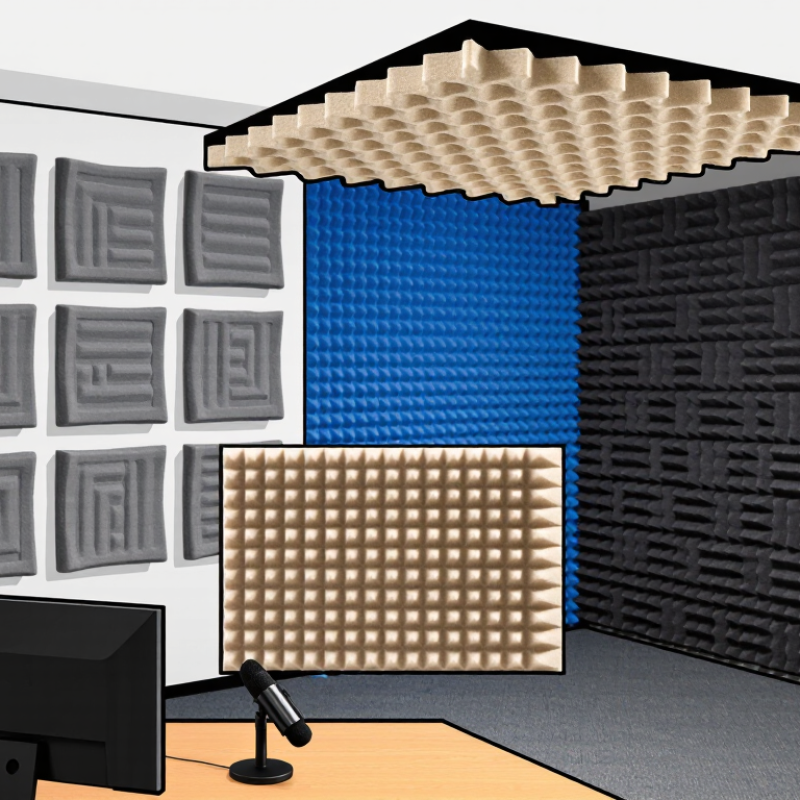
Common options include flat acoustic panels, wedge and egg-crate profiles, pyramid foam, and thicker bass traps. Each has a different shape, thickness, and intended use. Open-cell polyurethane foam is widely used for general absorption, while melamine foam is often selected where its material properties suit the room. These products can help control reflections, especially at middle and higher frequencies. Low-frequency sound is harder to manage. Thin foam alone may leave a room’s bass problems largely unchanged.

Small details count. A panel above a desk may reduce a sharp flutter echo; a few scattered tiles may do much less than expected. Coverage, placement, room dimensions, and product performance all affect results. Check published absorption data and fire-safety information before buying, since appearance alone tells you little. There is no single best type for every space. It is easy to overestimate what foam can fix, and that is worth remembering. The sections ahead compare the main types, their strengths, and the situations where another treatment may be more suitable.
What Are the Top Types of Sound Absorbing Foam?

Define Acoustic Foam by NRC: 250–2,000 Hz Ratings Under ASTM C423

Sound-absorbing foam is commonly made from open-cell polyurethane or melamine. It may have a flat, wedge-shaped, or convoluted surface. These shapes change the exposed area, but shape alone cannot tell you how well a panel absorbs sound. Look for test data.

NRC, or Noise Reduction Coefficient, summarizes absorption at 250, 500, 1,000, and 2,000 Hz. The four measured coefficients are averaged and rounded to the nearest 0.05. ASTM C423 describes a reverberation-room test method used to measure sound absorption. A listed NRC therefore reflects a tested sample and setup, not every wall, room, or installation.

Small details matter. Foam thickness, mounting, and air gaps can affect performance, especially at lower frequencies.

A higher NRC generally means more absorption across those four test bands, but it does not describe every frequency equally. Nor does it mean a room becomes soundproof. Not a sound barrier.

For a practical comparison, check that products were tested under ASTM C423 and note the foam thickness and mounting details. Even then, treat the number as a guide; room furnishings and placement can change what you hear.

Open-Cell Polyurethane Foam: Wedge, Pyramid, and Flat-Panel Profiles

Open-cell polyurethane foam absorbs sound when air moves through its connected pores. Wedge profiles place angled ridges toward the room, adding exposed surface without making the whole panel thicker. They suit control rooms and practice spaces where mid- and high-frequency reflections need taming. But wedges do not magically stop bass. A thin, lightweight panel still absorbs less low-frequency energy than thicker treatment.

Pyramid profiles use pointed peaks and valleys, creating a more irregular surface. They can soften reflections, though foam absorption—not true sound diffusion—does most of the work. Flat panels look calmer and are easier to wipe, fit, and arrange in neat rows; their smooth faces offer less surface area. ASTM C423 test reports measure absorption in a reverberation room, while NRC averages results at 250, 500, 1,000, and 2,000 Hz. ANSI/ASA S12.60 sets an NRC 0.70 benchmark for classroom ceiling materials, a useful reference rather than a guarantee for foam. Check the actual panel’s test report: thickness, mounting, and air gap change results. I would not choose by profile alone. Foam can also look uneven after cutting, and that detail is easy to miss.

Melamine Foam: Lightweight, Open-Cell Absorption for Interior Applications

Melamine foam is a lightweight, open-cell material that absorbs sound as air moves through its fine, connected pores. Its soft surface and low weight make it practical for interior walls, ceilings, and equipment enclosures. It is often most useful for reducing reflections and reverberation, especially in rooms with hard floors, glass, or bare plaster. Speech may sound less sharp. The room can feel calmer.

Thickness and placement matter. A thin sheet placed over a small area may have little effect on the overall room sound. More coverage, greater thickness, or a small air gap behind the foam can improve absorption, depending on the frequencies involved. Results vary.

Melamine foam is not a soundproofing barrier. It will not reliably stop noise traveling through a wall or between rooms. That distinction is easy to overlook. Before choosing it, check the manufacturer’s test data, installation guidance, and fire-performance information for the specific product. Requirements can differ by building and application. The material can also be delicate, so exposed edges may wear in busy spaces. A neat panel is not automatically an effective one; placement should respond to the room’s actual echo and use.

Compare Foam Profiles by Thickness, Density, and Frequency Response

What Are the Top Types of Sound Absorbing Foam?

Foam profiles differ in shape, thickness, and how they handle sound. Flat panels offer a simple surface for walls or ceilings. Wedge and pyramid profiles add grooves that increase exposed area, but shape alone does not guarantee stronger absorption. A thin, deeply sculpted panel may absorb less low-frequency sound than a thicker, flatter panel. Check test data when available.

Thickness usually matters more at lower frequencies. A 25-millimeter panel can soften reflections and sharp echoes, especially in the upper and middle ranges. Thicker foam, or a panel mounted with an air gap, can reach further into lower-mid frequencies. Density matters too, but it is not a reliable quality score by itself. The foam’s airflow resistance and structure affect performance. Bass is tricky.

Tips: Match the panel to the problem. For a bright, echoing room, place panels near reflection points and listen for changes. For a persistent low hum, foam alone may disappoint; measure the room and consider thicker treatment. Keep a small untreated area for comparison. Results can be uneven, and I would reassess placement after a few days.

Select Foam Using ASTM C423 NRC Data and ISO 354 Absorption Tests

Choosing sound-absorbing foam by appearance alone can mislead. Open-cell polyurethane, melamine foam, and shaped panels may all reduce reflections, but their performance depends on thickness, mounting, and frequency. Ask for laboratory results, not just claims such as “high absorption.” Useful evidence comes from ASTM C423 and ISO 354 reverberation-room tests.

ASTM C423 reports absorption by frequency and an NRC value. NRC is the rounded average of coefficients at 250, 500, 1,000, and 2,000 Hz. That single number is convenient, but it can hide weak low-frequency performance. ISO 354 provides frequency-band absorption results from a reverberation-room method, making it easier to compare behavior across the spectrum. Check the test report’s sample thickness, air gap, mounting method, and specimen size; each can change the result. Small details matter. A 50 mm panel installed with a 50 mm cavity is not directly comparable to the same panel fixed flat to a wall. Compare test conditions before comparing scores, and treat a high NRC as one clue—not a promise of quieter rooms.

What Are the Top Types of Sound Absorbing Foam?

Use ASTM C423 NRC Data and ISO 354 Absorption Tests to compare tested performance—not material names alone.

The chart shows frequency-band coverage, not sound absorption performance: NRC is calculated from absorption coefficients at 250, 500, 1,000, and 2,000 Hz, while ISO 354 covers measurements from 100 to 5,000 Hz. Common options include open-cell polyurethane, melamine, and reticulated polyurethane foam. Their absorption depends on thickness, mounting, and test conditions, so compare ASTM C423 or ISO 354 reports for the specific construction rather than assuming a universal NRC for a foam type.